
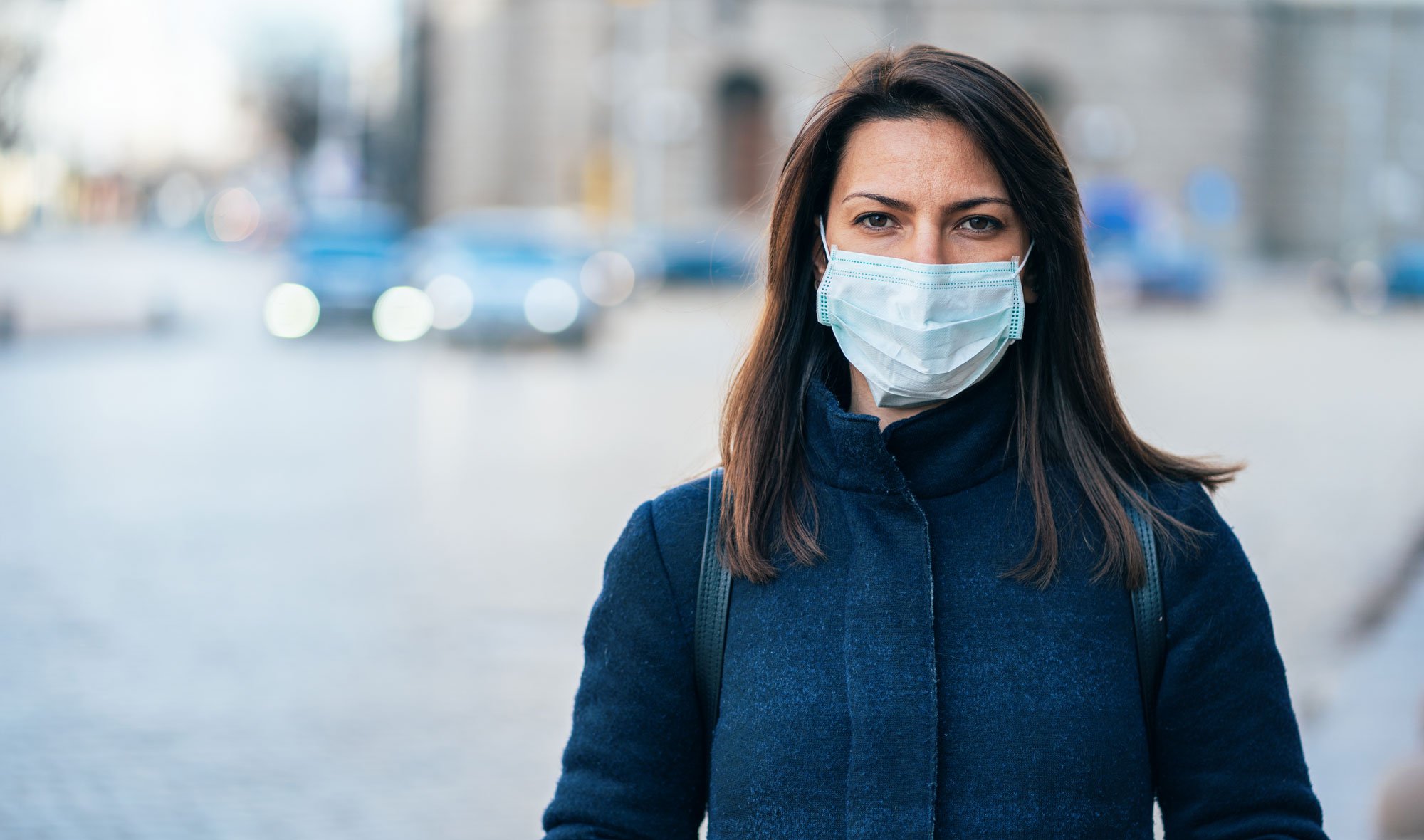
Some users of social media are claiming that a “Stanford University” or “NIH” (part of the USA's Department of Health and Human Services) study has shown that face masks are ineffective against the Covid-19 coronavirus and even harmful. There’s one problem with that claim though. It’s not really a Stanford study or a National Institutes of Health (NIH) study.
OK, there are two problems with that claim: it’s not a Stanford study, it’s not an NIH study, and, in fact, it’s not even really a study. All right, there are three problems with that claim: it’s not a Stanford study, it’s not an NIH study, it’s not really a study, and oh, it didn’t really show that face masks are ineffective against the Covid-19 coronavirus. Check that, there are four problems with that claim: it’s not a Stanford study, it’s not an NIH study, it’s not really a study, it didn’t really show that face masks are ineffective against the Covid-19 coronavirus, and by the way it didn’t really show that face masks are even harmful.
Umm, let’s start again.
Recently, there have been posts on social media, claiming that a “Stanford study”, “Stanford mask”, or a “Stanford face mask study” showed that face masks are ineffective against the Covid-19 coronavirus and may have “devastating health consequences”, and that the same “study” is from the NIH or was supported by the NIH.
But, and it's a big BUT, the sole author of the publication is someone named Baruch Vainshelboim, PhD who is not actually “from Stanford,” when it comes to properly designating from where the study came. It looks like the publication has him listed as being affiliated with the Cardiology Division at the Veterans Affairs Palo Alto Health Care System and Stanford University. However, that appears to be like a worn out underwear band as Stanford Medicine describe him as a one -year visiting scholar, and that's very different from being a true faculty member.
Also, the publication’s only connection with the NIH is that it can be found on PubMed. PubMed is a database and search engine maintained by the NIH’s National Library of Medicine (NLM). The database includes all articles that are published in a variety of biomedical and life sciences journals.
So rather than being published by, for, in, at, through, on, over, under, or on top of the NIH, the publication entitled “Facemasks in the Covid-19 era: A health hypothesis,” was actually published in a journal called Medical Hypotheses, one of over 5,000 titles that are currently indexed in PubMed which range significantly in type, quality, and focus. Some of the journals in PubMed don’t even publish scientific studies, instead focusing more on other types of papers such as commentaries, review papers, or, in the case of Medical Hypotheses: “theoretical papers.”
Yes, this journal actually published papers “which describe theories, ideas which have a great deal of observational support and some hypotheses where experimental support is yet fragmentary.” Can you imagine being asked or told to eat something with a caveat like “support that the thing is edible and won’t hurt you is fragmentary” or telling you just before a skydive that “the quality checks for parachute have been fragmentary?”
The journal description also states that that Medical Hypotheses will “give novel, radical new ideas and speculations in medicine open-minded consideration, opening the field to radical hypotheses which would be rejected by most conventional journals.” Would you feel reassured just before an operation by the surgeon telling you that he/she is "going to try a radical hypothesis that would be rejected by most conventional medical journals?”
After all, Dictionary.com indicates that “a scientific hypothesis is made before testing is done and isn’t based on results. Instead, it is the basis for further investigation.” It also says that hypothesis refers to “a proposition assumed as a premise in an argument,” or “mere assumption or guess.”
Medical Hypotheses is the journal that has published things like “Is there an association between the use of heeled footwear and schizophrenia”, “Ejaculation as a potential treatment of nasal congestion in mature males”, and “Losing weight by defecating at night.” Before you start wearing flip-flops all the time, masturbating furiously when you’ve got a stuffy nose, and sleeping on the toilet bowl, keep in mind that such articles, commentaries, and letters in Medical Hypotheses merely advance hypotheses without necessarily providing enough scientific evidence or any for that matter. After all, how many legitimate doctors will tell you, “hmm, to help us decide what treatment to give you, let’s take a look at Medical Hypotheses?” So if you have a radical idea that would be rejected by other scientific journals and a spare $1850 to pay the journal, you may be able to publish that idea in Medical Hypotheses.
Anyway, back to Vainshelboim’s article (which is not a study) about face masks presents arguments that fly in the face of scientific evidence and does so in highly flawed manner. First, when trying to claim that face masks are not effective against the Covid-19 coronavirus, the article interestingly focuses on studies of other types of respiratory viruses instead. It fails to mention the studies from 2020 that supported the use of face masks in preventing the spread of the severe acute respiratory syndrome (SARS-CoV2). As has been repeated over and over again, Covid-19 is not the flu. The SARS-CoV2 is not like influenza and some of the other respiratory viruses that Vainshelboim mentions. It seems to be more transmissible through the air, hence the face mask requirements.
Secondly, the article makes a number of leaps that really are not justified. For example, it claims that “trapped air remaining between the mouth, nose and the facemask is rebreathed repeatedly in and out of the body, containing low O2 and high CO2 concentrations, causing hypoxemia and hypercapnia,” and then cites some book chapters without really explaining how exactly these book chapters might support this claim. Is this a bit like claiming that you are an amazing lover and then citing The Joy of Sex?
Keep in mind that wearing a standard face mask is not the same as wearing a fish bowl or solid concrete and a microwave oven around your head. Oxygen and carbon dioxide should be able to move through the face mask material, assuming that you didn’t just take a condom and stretch it over your nose and mouth.
Then the article says, “severe hypoxemia may also provoke cardiopulmonary and neurological complications and is considered an important clinical sign in cardiopulmonary medicine.” How exactly would a standard face mask, which again allows oxygen to pass through its material, even cause “severe” hypoxemia, which is very low levels of oxygen in the blood, in most healthy people? If your oxygen levels have ever gotten that low, there’s a good chance that you would have already felt lightheaded, short of breath, and like you are going to pass out before experiencing any more longer term problems. This makes the next statement in the article potentially misleading: “low oxygen content in the arterial blood can cause myocardial ischemia, serious arrhythmias, right or left ventricular dysfunction, dizziness, hypotension, syncope and pulmonary hypertension.” A person doesn’t just develop conditions like a heart attack (which is apparently myocardial ischemia) or pulmonary hypotension just from wearing a face mask. These are conditions that develop over time from other factors. For example, a person typically has underlying coronary artery disease before suffering a heart attack.
I'm all for debate and the sharing of information, but it needs to be open, honest and accurate. In this instance, it's surely theoretically possible that someone convinced by the article to not wear face masks, catches and transmits the Covid-19 coronavirus to someone else as a result? The other person could end up suffering or even dying. And that’s not just a hypothesis, given how much the article is getting shared on social media and used an ammunition in a war against mask wearing, it’s a real concern.


