
I'm currently watching Sky News in a London hotel prior to tomorrow's assessment conference and wondering how exactly Fred Goodwin has "brought the honours system into disrepute"? He didn't award himself the knighthood that the queen has just withdrawn; all he did was accept it. You could probably argue that he brought himself into disrepute by graceless behaviour and reckless management of the Royal Bank of Scotland. And you could also make a case that he brought the banking industry into disrepute (admittedly in conjunction with many other supposedly leading lights). But the honours system? That charge really ought to be levelled at those who recommended and confirmed the award for "services to banking" for someone who was effectively just gambling with someone else's money.
Now, it's not that I'm particularly advocating that (the now) Mr Goodwin deserves to keep his knighthood, but unlike previously dispossessed knights, he is not a criminal or a traitor, just someone who didn't turn out to have been quite so brilliant a banker as they thought him to be when bestowing the award in the first place. So it occurs to me that if you consider the many still-knighted leading bankers who must be grateful to Fred Goodwin for effectively taking the public flak on their behalf, you might conceivably say that he's performed his fellow money men a great service. And doesn't great service eventually lead to honours? A knighthood perhaps?....
Tuesday, 31 January 2012


Friday, 6 January 2012
Troweller in Error
Much as I agree that gardening is important, after all the Office for National Statistics has declared it to be one of the few activities which make people of all income levels and national origins happier, but television gardener Alan Titchmarsh has told this week's Radio Times that "Gardening is more important than politics [because] it has a consistent point of view".
No explanation is supplied as to how he considers domestic agriculture on any scale able to hold a viewpoint, consistent or otherwise, or why political variability is apparently undesirable (surely the point of democracy is that change can, and does, happen?), but those of us who thought the appeal of gardening to be creative joy, useful solitude or a connection to nature, are now aware that in addition to the pruning, planting and potting: there's philosophy!
No explanation is supplied as to how he considers domestic agriculture on any scale able to hold a viewpoint, consistent or otherwise, or why political variability is apparently undesirable (surely the point of democracy is that change can, and does, happen?), but those of us who thought the appeal of gardening to be creative joy, useful solitude or a connection to nature, are now aware that in addition to the pruning, planting and potting: there's philosophy!
Thursday, 27 October 2011
Much ado about nothing sensible
Now I know that Hollywood produces works of fiction, and takes very extensive liberties with any actual facts upon which a story might be based, but I've just seen on the hotel television a report about the new film Anonymous which said that Sony Pictures were intending to send out "information packs" to schools to promote its release.
Not only did the reporter not point out how far from reality the film's basis actually is, she actually suggested that it was based on a credible theory which hadn't been disproved.
Well, let me have a go, and this is without even trying very hard...
The film advances the claim that Shakespeare’s works were written by Edward de Vere, 17th Earl of Oxford, who died in 1604. This was before 12 of Shakespeare’s plays were written, a year prior to the Gunpowder Plot alluded to in Macbeth, and five years before the Sea Venture ran aground off Bermuda and inspired The Tempest.
And that's without even trying to pull apart the "possibility" that De Vere put his own name to comparatively poor poetry while submitting works of genius behind an alias to a rival’s theatre company...
Quick (and admittedly not triangulated) research on Google tells me that the originator of this unintellectual drivel is an aptly named J.Thomas Looney, but unfortunately the stuff our schools might be getting won't come with a Looney Tunes label on the cover, just something that says it's "supporting education".
Not only did the reporter not point out how far from reality the film's basis actually is, she actually suggested that it was based on a credible theory which hadn't been disproved.
Well, let me have a go, and this is without even trying very hard...
The film advances the claim that Shakespeare’s works were written by Edward de Vere, 17th Earl of Oxford, who died in 1604. This was before 12 of Shakespeare’s plays were written, a year prior to the Gunpowder Plot alluded to in Macbeth, and five years before the Sea Venture ran aground off Bermuda and inspired The Tempest.
And that's without even trying to pull apart the "possibility" that De Vere put his own name to comparatively poor poetry while submitting works of genius behind an alias to a rival’s theatre company...
Quick (and admittedly not triangulated) research on Google tells me that the originator of this unintellectual drivel is an aptly named J.Thomas Looney, but unfortunately the stuff our schools might be getting won't come with a Looney Tunes label on the cover, just something that says it's "supporting education".
Friday, 21 October 2011
Capital (ism) in action
Walking back to Kings Cross after the HEFCE/AoC Additional Numbers workshop yesterday, I passed the latest tented village to spring up on the streets of our capital: the one apparently welcomed by Giles Fraser, the Canon Chancellor of St Paul’s Cathedral when the Occupy London Stock Exchange protesters gathered at the start of the week.
Now though, with the Evening Standard claiming that this national icon could be closed due to health and safety issues, he's not quite so keen. The position has rapidly moved on from his only telling the police to go away (Monday) to complaining that tourists are no longer visiting his Baroque masterpiece (Thursday) and therefore aren't contributing to its upkeep. Or to put it in free market terms: no visitors equals nothing spent in the gift shop, no food bought in the restaurant, and no donations from those with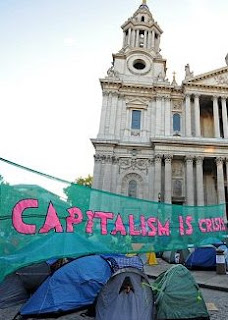 change to spare.
The free paper also includes an interview with Naomi Colvin, spokesperson for the protesters, who says that money might be raised to compensate the church for its losses, but she's obviously not bothered to think through how much needs to be put into the collecting tin to balance the lost income of one of the ten most popular tourist attractions in the country.
This is capitalism in action: it's not slogans, protests and collective sleepovers, it's a businessman (for that's effectively what Canon Fraser is) unable to predict the effect of 200 demonstrators outside his door on passing trade, customer access and turnover, and a well-meaning motley crew closing him down because of his naivety.
Leads me to wonder, that since neither of the parties involved seem to understand what they've got themselves into, maybe they ought to start charging the likes of me to take photographs of the tents and possibly sell some refreshments while they're doing it?
Then, they could simply give the money raised to the church and everybody would be happy; except possibly protesters protesting about protester's profiteering...
Now though, with the Evening Standard claiming that this national icon could be closed due to health and safety issues, he's not quite so keen. The position has rapidly moved on from his only telling the police to go away (Monday) to complaining that tourists are no longer visiting his Baroque masterpiece (Thursday) and therefore aren't contributing to its upkeep. Or to put it in free market terms: no visitors equals nothing spent in the gift shop, no food bought in the restaurant, and no donations from those with
 change to spare.
The free paper also includes an interview with Naomi Colvin, spokesperson for the protesters, who says that money might be raised to compensate the church for its losses, but she's obviously not bothered to think through how much needs to be put into the collecting tin to balance the lost income of one of the ten most popular tourist attractions in the country.
This is capitalism in action: it's not slogans, protests and collective sleepovers, it's a businessman (for that's effectively what Canon Fraser is) unable to predict the effect of 200 demonstrators outside his door on passing trade, customer access and turnover, and a well-meaning motley crew closing him down because of his naivety.
Leads me to wonder, that since neither of the parties involved seem to understand what they've got themselves into, maybe they ought to start charging the likes of me to take photographs of the tents and possibly sell some refreshments while they're doing it?
Then, they could simply give the money raised to the church and everybody would be happy; except possibly protesters protesting about protester's profiteering...
Wednesday, 28 September 2011
To Beeb or not to Beeb, was there a question?
Visiting my father yesterday on the way back from another post-presentation trans-pennine drive, I was amused (and sceptical!) to learn that the BBC had decided to ban the use of BC and AD in favour of the more pensioner-confusing terms BCE (Before Common Era) and CE (Common Era).
Evidently, the front page of his Mail on Sunday displayed the banner headline "BBC turns its back on year of Our Lord" and followed it with claims that executives at the public broadcaster had banned the use of the dating terms and insisted that they be replaced with more "politically correct" ones. As I'm sure you'd agree, this would be an impressive feat even for an organisation with the Beeb's influence, but could it really "jettison 2,000 years of history"?
Well, er, no, as actually reading to the last paragraph makes clear via a spokesperson from the broadcaster...
"The BBC has not issued editorial guidance on the date systems. Both AD and BC, and CE and BCE are widely accepted date systems and the decision on which term to use lies with individual production and editorial teams."
So where did this "story" come from and why does the Mail want to castigate the Corporation for simply saying that two dating systems are common and staff can use whichever they prefer? The BBC's "politically correct, Europhile agenda" is cited as the cause, although how either has any relevance is utterly beyond me. It's not exactly an adherence to "political correctness" to tell people that they can use whatever words they like, and no stretch of my imagination can get even close to any reason why or how Europe might fit in.
As it happens, only a minimal amount of research is necessary to ascertain where the story started, but quite why it's developed into incoherent rage is much more of a puzzle.
On the Frequently Asked Questions page part of the BBC Religion religion website there's a bit saying:
"In line with modern practice bbc.co.uk/religion uses BCE/CE (Before Common Era/Common Era) as a religiously neutral alternative to BC/AD. As the BBC is committed to impartiality it is appropriate that we use terms that do not offend or alienate non-Christians."
a paragraph which is basically talking only about the BBC Religion web site, not making statements about BBC-wide policy, and has probably been there for some considerable time as there's nothing at all to indicates that this is some new rule.
Indeed, as the Qualifications and Curriculum Authority guidelines say "CE/BCE is becoming an industry standard among historians," and "pupils have to be able to recognise these terms when they come across them", why should the BBC be only now issuing edicts about the use of terminology that's been around for over 150 years?
Going back only a week, one of the Mail on Sunday columnists has written in a review of University Challenge that "Jeremy Paxman referred to a date as being Common Era, rather than AD. This nasty formulation is designed to write Christianity out of our culture."
This was followed on Saturday by a piece entitled "How the BBC fell for a Marxist plot to destroy civilisation from within" which links the above irritation to the BBC's website FAQ page (that's how I found it!) and proclaims
"No longer will [The BBC's] website refer to those bigoted, Christian-centric concepts AD (as in Anno Domini – the Year of Our Lord) and BC (Before Christ). From now on, it will use initials which strip our traditional Gregorian calendar of its offensive religious context. All reference to Christ has been expunged, replaced by the terms CE (Common Era) and BCE (Before Common Era)."
So by the time we get to Sunday, a columnist's trivial annoyance with a quiz show, a BBC FAQ and some incoherent rantings built on non-existent foundations have evolved into a full-page story which has fuelled over 1,500 on-line comments from Mail readers (mainly) unable to read past a headline!
Evidently, the front page of his Mail on Sunday displayed the banner headline "BBC turns its back on year of Our Lord" and followed it with claims that executives at the public broadcaster had banned the use of the dating terms and insisted that they be replaced with more "politically correct" ones. As I'm sure you'd agree, this would be an impressive feat even for an organisation with the Beeb's influence, but could it really "jettison 2,000 years of history"?
Well, er, no, as actually reading to the last paragraph makes clear via a spokesperson from the broadcaster...
"The BBC has not issued editorial guidance on the date systems. Both AD and BC, and CE and BCE are widely accepted date systems and the decision on which term to use lies with individual production and editorial teams."
So where did this "story" come from and why does the Mail want to castigate the Corporation for simply saying that two dating systems are common and staff can use whichever they prefer? The BBC's "politically correct, Europhile agenda" is cited as the cause, although how either has any relevance is utterly beyond me. It's not exactly an adherence to "political correctness" to tell people that they can use whatever words they like, and no stretch of my imagination can get even close to any reason why or how Europe might fit in.
As it happens, only a minimal amount of research is necessary to ascertain where the story started, but quite why it's developed into incoherent rage is much more of a puzzle.
On the Frequently Asked Questions page part of the BBC Religion religion website there's a bit saying:
"In line with modern practice bbc.co.uk/religion uses BCE/CE (Before Common Era/Common Era) as a religiously neutral alternative to BC/AD. As the BBC is committed to impartiality it is appropriate that we use terms that do not offend or alienate non-Christians."
a paragraph which is basically talking only about the BBC Religion web site, not making statements about BBC-wide policy, and has probably been there for some considerable time as there's nothing at all to indicates that this is some new rule.
Indeed, as the Qualifications and Curriculum Authority guidelines say "CE/BCE is becoming an industry standard among historians," and "pupils have to be able to recognise these terms when they come across them", why should the BBC be only now issuing edicts about the use of terminology that's been around for over 150 years?
Going back only a week, one of the Mail on Sunday columnists has written in a review of University Challenge that "Jeremy Paxman referred to a date as being Common Era, rather than AD. This nasty formulation is designed to write Christianity out of our culture."
This was followed on Saturday by a piece entitled "How the BBC fell for a Marxist plot to destroy civilisation from within" which links the above irritation to the BBC's website FAQ page (that's how I found it!) and proclaims
"No longer will [The BBC's] website refer to those bigoted, Christian-centric concepts AD (as in Anno Domini – the Year of Our Lord) and BC (Before Christ). From now on, it will use initials which strip our traditional Gregorian calendar of its offensive religious context. All reference to Christ has been expunged, replaced by the terms CE (Common Era) and BCE (Before Common Era)."
So by the time we get to Sunday, a columnist's trivial annoyance with a quiz show, a BBC FAQ and some incoherent rantings built on non-existent foundations have evolved into a full-page story which has fuelled over 1,500 on-line comments from Mail readers (mainly) unable to read past a headline!
Tuesday, 16 August 2011
Beware: Ninja Tellys!
After a six hour train journey, I'm now sat in a central Oxford hotel watching television before retiring for the night, a pastime that I've always thought relaxing but according to an article in today's Times is actually hazardous to my health ("TV is as harmful as smoking"). Indeed, every hour spent slumped in front of the box is as "serious a public health problem as smoking or obesity" and can reduce the viewer's life expectancy by 22 minutes, or in other words, you'll live 5 years less if you watch TV for 6 hours a day.
So does that magic box in the corner of the room emit some previously secret carcinogenic rays?
Does a seemingly endless stream of reality drivel, soap operas and gameshows have an adverse affect on the will to live?
Nope, "research" published in the British Journal of Sports Medicine has compared the mortality rates of couch potato Australians with those who had "more active lifestyles". Then, after doing a few sums, the University of Queensland "experts" worked out that every hour spent glued to the screen shortened life by 21.8 minutes, and the "top 1 per cent of the population who watch six hours of programmes a day can expect to live 4.8 years less than a person who does not watch TV”.
So that's not a slow-acting electric assassin in the corner of the room after all. Not only will it not kill me, it won't even reduce my life expectancy, because all these "researchers" have actually done is correlate some data which shows that more active people tend to live longer. Wow!
On the other hand, the report also quotes a Lancet article claiming that "as little as 15 minutes of physical activity every day can increase lifespan by three years", which by my calculations means that I only need to do around 3 minutes of exercise for every hour's telly watching and they'll cancel each other out.
Fortunately for the reputation of the academic community as a whole, and as the participants in tomorrow's scholarly activity workshop will be told at 10.00am, getting your work published isn't quite like Homer Simpson once said, "Facts are meaningless. You could use facts to prove anything that's even remotely true....."
So does that magic box in the corner of the room emit some previously secret carcinogenic rays?
Does a seemingly endless stream of reality drivel, soap operas and gameshows have an adverse affect on the will to live?
Nope, "research" published in the British Journal of Sports Medicine has compared the mortality rates of couch potato Australians with those who had "more active lifestyles". Then, after doing a few sums, the University of Queensland "experts" worked out that every hour spent glued to the screen shortened life by 21.8 minutes, and the "top 1 per cent of the population who watch six hours of programmes a day can expect to live 4.8 years less than a person who does not watch TV”.
So that's not a slow-acting electric assassin in the corner of the room after all. Not only will it not kill me, it won't even reduce my life expectancy, because all these "researchers" have actually done is correlate some data which shows that more active people tend to live longer. Wow!
On the other hand, the report also quotes a Lancet article claiming that "as little as 15 minutes of physical activity every day can increase lifespan by three years", which by my calculations means that I only need to do around 3 minutes of exercise for every hour's telly watching and they'll cancel each other out.
Fortunately for the reputation of the academic community as a whole, and as the participants in tomorrow's scholarly activity workshop will be told at 10.00am, getting your work published isn't quite like Homer Simpson once said, "Facts are meaningless. You could use facts to prove anything that's even remotely true....."
Wednesday, 27 July 2011
Skullduggery
Today's BBC Science website headlines the revelation that anthropologists from Oxford University have examined 55 human skulls from various parts of the world and concluded that we in the North have bigger brains than those who hail from the South.
According to lead author Eiluned Pearce: "We found a positive relationship between absolute latitude ... and cranial capacity" which suggests that a few tens of thousands of years peering through the gloom of long winters and brief springs has enlarged northern brains in the same sort of way that a series of gym sessions is likely to increase the size of one's biceps/pectorals/deltoids/etc.
The Royal Society's Biology Letters journal goes on to say that this hasn't necessarily made Northerners more intelligent, however, it is now over 200 years since Canon Sydney Smith, Dean of St. Paul's Cathedral (born in Woodford, Essex but obviously in possession of something akin to a Big Northern Brain) pre-empted the team's doubts on the matter by saying:
"Never ask a man if he comes from Yorkshire. If he does, he will tell you. If he does not, why humiliate him?".
Of course, it's now only natural modesty which prevents me speculating as to whether or not next week's news might confirm the Pope's religion or enlighten us on what bears do in the woods....
According to lead author Eiluned Pearce: "We found a positive relationship between absolute latitude ... and cranial capacity" which suggests that a few tens of thousands of years peering through the gloom of long winters and brief springs has enlarged northern brains in the same sort of way that a series of gym sessions is likely to increase the size of one's biceps/pectorals/deltoids/etc.
The Royal Society's Biology Letters journal goes on to say that this hasn't necessarily made Northerners more intelligent, however, it is now over 200 years since Canon Sydney Smith, Dean of St. Paul's Cathedral (born in Woodford, Essex but obviously in possession of something akin to a Big Northern Brain) pre-empted the team's doubts on the matter by saying:
"Never ask a man if he comes from Yorkshire. If he does, he will tell you. If he does not, why humiliate him?".
Of course, it's now only natural modesty which prevents me speculating as to whether or not next week's news might confirm the Pope's religion or enlighten us on what bears do in the woods....
Subscribe to:
Posts (Atom)